Artificial intelligence is the topic of the moment, but there is a significant gap between hype and reality. Many AI initiatives fail because they remain stuck in the proof-of-concept phase. The root cause is rarely the technology itself, but rather a lack of understanding of data, processes, and real-world use cases.
Why field service is at a turning point
Few topics are currently transforming business and the workplace as profoundly as artificial intelligence. New solutions emerge almost daily, aiming to accelerate processes and improve decision-making. Where experience and routine once sufficed, organizations now face increasing speed, complexity, and rising expectations.
Customers demand transparency, availability, and reliability – anytime and anywhere. At the same time, labor shortages, new business models, and sustainability targets are reshaping the rules. In this environment, incremental improvements are no longer sufficient. Service must be rethought: connected, intelligent, and proactive. This is where AI can deliver value, but only when applied strategically and focused on solving real problems.
Why many AI projects fail
Service organizations need new approaches. But where to start, and how does AI become truly useful in daily operations? Organizations are not looking for additional tools that increase complexity, they are looking for support in solving core operational challenges:
- How can service scheduling be improved?
- How can knowledge be delivered where it is needed?
- How can customer service become faster, more accurate, and more transparent?
Many companies launch AI initiatives with high expectations, yet fail to transition into productive operations. Studies show that up to 88%* of AI projects remain stuck in proof-of-concept stages. The issue is rarely technology, it is the lack of implementation within real service environments.
In field service, one reality becomes clear: an AI that is only 80% accurate is not deployable.
Use cases instead of buzzwords: where AI creates real impact
Successful AI strategies are not driven by buzzwords, but by clearly defined use cases.
Field technicians benefit from support in diagnostics, automated service reporting, and access to knowledge from previous service jobs. Dispatchers gain value from predictive planning, improved routing and resource allocation in real time, and forecasting of workload and capacity. Customers experience transparent service, faster responses, and fewer unplanned outages.
„We currently manage 190 technicians. SERVICE 1 supports us in daily dispatching, automatically improves routing, and delivers the most relevant job details directly to each technician’s mobile device.“
Eike Schmereim, Head of Customer Service
STIEBEL ELTRON GmbH & Co. KG
The benefits are measurable. Companies significantly reduce manual email processing, automate large parts of their call center operations, and drastically shorten response times. At the same time, experiential knowledge is systematically captured and made accessible across the organization.
85–90% cost savings through email automation: In many service departments, hundreds of emails are manually reviewed, categorized, and forwarded each day. AI automatically classifies incoming messages, prioritizes them, and converts them into service tickets. Response times are reduced from hours to minutes.
30–50% automation in the call center: Approximately 70% of calls are routine. An intelligent voice agent understands requests in natural language, verifies customer data, and independently resolves routine issues. Employees gain time for high-value, personal interactions.
Faster response and resolution times: Automated prioritization and intelligent knowledge delivery ensure that information reaches the right place faster, accelerating decision-making and reducing wait times.
Preservation and transfer of knowledge: In times of skilled labor shortages, knowledge becomes the most critical asset. AI makes experience documentable and accessible at any time. Knowledge is retained, even when employees leave.
Conclusion: Think digital. Act human.
Artificial intelligence is transforming the way we work: faster, more fundamentally, and more sustainably than any previous technology. Yet one truth remains: service is, and will remain, human.
AI can accelerate processes, support decision-making, and connect knowledge—but it does not replace experience, empathy, or accountability. The goal is not to replace people. The goal is to make them more effective.
Successful service transformation does not start in the cloud, it starts in mindset. It begins where organizations are willing to take new paths, with a partner who understands them. A partner who combines technology with deep process expertise and turns AI hype into measurable impact.
The future of field service is intelligent, connected, and proactive.
But above all: human.
AI in Service – Think digital, act human
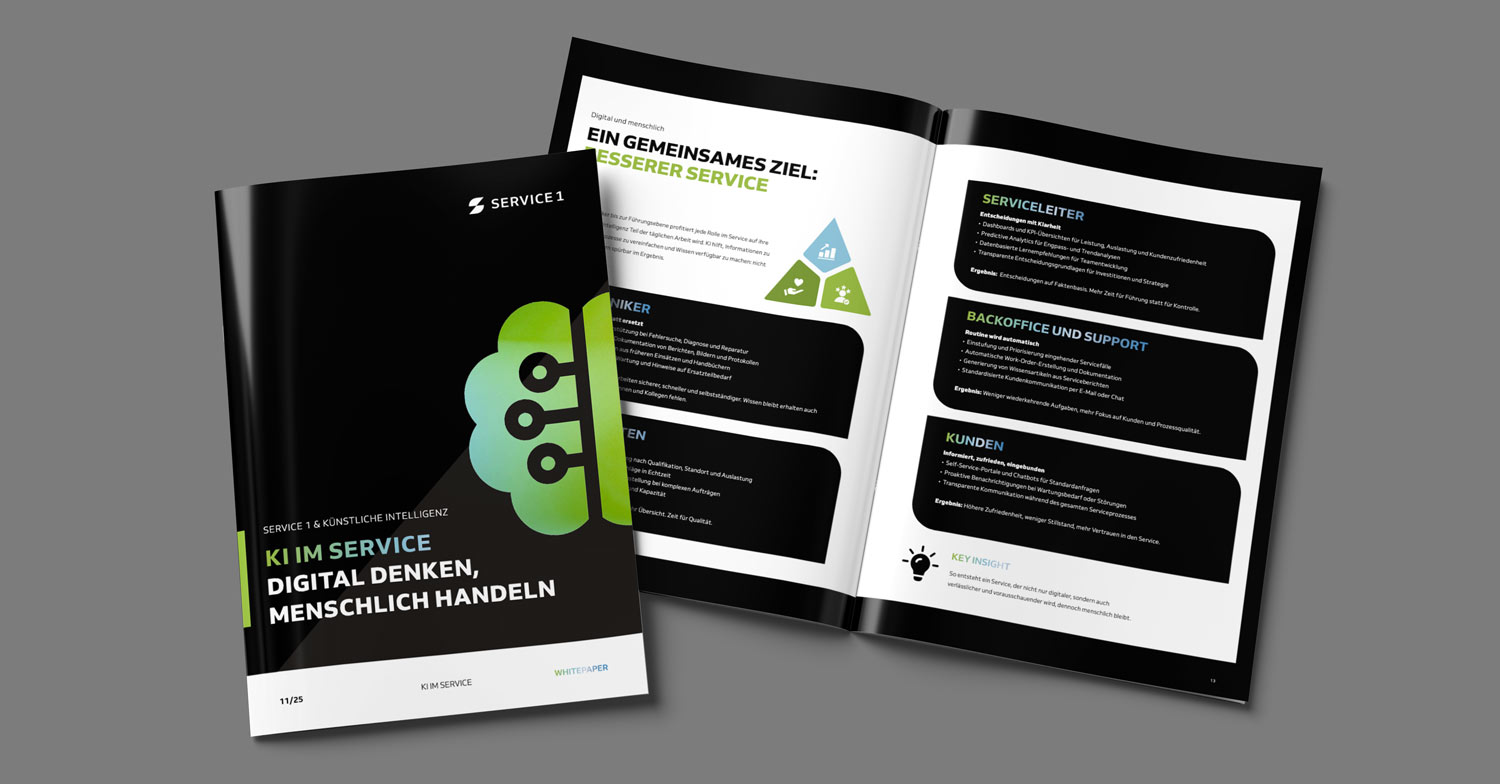
This whitepaper shows how companies can create real value step by step through intelligent processes, empowered teams, and more satisfied customers.
FAQ on AI in Field Service
Service is at a turning point, as customers demand faster response times while labor shortages and increasing operational pressure challenge organizations. AI helps automate routine tasks, connect knowledge, and support decision-making. It enables service organizations to operate faster, more effectively, and more sustainably, transforming service from a cost center into a revenue driver.
AI acts as a digital assistant that supports technicians in troubleshooting, diagnostics, and repair in real time. Voice-enabled capabilities allow service reports to be created automatically, eliminating manual data entry and system fragmentation. Technicians also gain direct access to knowledge from previous service jobs and documentation, enabling more confident and autonomous work.
Studies show that a large proportion of AI projects remain stuck in proof-of-concept stages, often due to a lack of understanding of real service processes or insufficient accuracy for live operations. To address this, SERVICE 1 follows a use-case-driven strategy. AI must be embedded as a reliable component within an operational process and deliver measurable value where it matters.
The use of AI delivers significant improvements: AI-driven email automation enables cost savings of up to 90% and reduces response times from hours to minutes. In call centers, approximately 70% of routine inquiries can be identified by intelligent voice agents, with 30–50% of these calls fully automated.
Learn more: AI in Service | References | Service Transformation Assessment