It’s Tuesday morning, 6:30 a.m. Somewhere in the North Sea
Two technicians are preparing for a maintenance job. Their spare parts were delivered overnight. Their checklist runs on a tablet – offline, as connectivity on the turbine is unreliable. As they work through the maintenance steps, they document directly in the system and access the integrated knowledge base when needed. On the way back, the system automatically schedules a second turbine located along their route.
No paperwork chaos. No calls to the control center. No lost service job.
The wind energy sector is booming. But can service keep up?
Europe’s installed wind energy capacity is expected to grow by more than 45% (source: WindEurope 2025) between 2025 and 2030. More assets, larger turbines, more remote locations – onshore across wide areas, offshore at sea. What is a positive signal for the energy transition quickly becomes a stress test for service organizations.
Growth creates pressure. Skilled field technicians are scarce, especially in rural areas. Wind turbines consist of thousands of components that require regular maintenance, monitoring, and documentation. Weather conditions can render service schedules obsolete overnight.
Many service organizations attempt to meet these demands using the same processes that worked five years ago: paper-based documentation, manual scheduling, Excel-based spare parts tracking. This does not scale. And it comes at a cost – lost uptime, higher downstream costs from failures, and dissatisfied operators.
What modern Field Service Management delivers in wind service
Digital FSM is not an IT project. It is an operating model. And it directly addresses the core challenges in wind service:
Decentralized assets and route optimization: AI-driven scheduling considers GPS location, technician skills, and spare parts availability in real time. The result: fewer empty trips, more jobs per day, and lower cost per service order.
Weather dependency and dynamic rescheduling: Daily schedules can be adjusted, swapped, reprioritized, or reallocated within seconds. No dispatcher making frantic calls. No technician uncertain about the next assignment.
Complex assets and lack of visibility: Cloud-based service platforms provide technicians on site with access to maintenance history, technical documentation, and digital twins. Fault diagnostics become faster, and first-time fix rates improve.
Documentation and compliance: Digital checklists, automated logging, and photo documentation replace paper-based processes. Compliance with customer and regulatory requirements becomes a byproduct, not an additional effort.
Knowledge management: A continuously learning knowledge base makes expert knowledge accessible across the entire team—even for technicians encountering a specific asset for the first time. Remote resolution rates increase. Repeat visits decrease.
What results do wind energy companies achieve with FSM software?
Companies using Field Service Management software report measurable improvements:
| KPI | Improvement |
|---|---|
| Planning effort | Reduction of more than 20% |
| Technician time per job | Reduction of more than 10 % |
| ROI period | 12 to 24 months |
| First-Time-Fix Rate | Significant increase through mobile knowledge access |
| Asset availability | Increase through predictive maintenance |
Source: SERVICE 1
The path to a digital service organization does not have to be complex
Many companies do not fail because of technology, but because of how they start. SERVICE 1 provides a structured transformation roadmap:
Service Value Assessment: In two workshops, experts analyze your key metrics, benchmark them against industry standards, and identify concrete quick wins. Result: a clear roadmap to achieve rapid ROI.
Service Transformation Assessment: Analysis of the entire service and IT landscape, development of a transformation strategy, and definition of initiatives and investment requirements.
Proof of Value: Before rollout, selected capabilities, such as automated scheduling based on your historical data can be tested. Your teams are aligned and confident before go-live.
Conclusion: Field Service Management is the key to scaling
The expansion of renewable energy in Europe is not scalable without high-performance Field Service Management. FSM software coordinates technicians, assets, and knowledge in real time, bridging the gap between reactive incident management and proactive, data-driven service operations.
Companies that adopt digital FSM early benefit from lower operating costs, higher asset availability, and a clear competitive advantage in the growing renewable energy market.
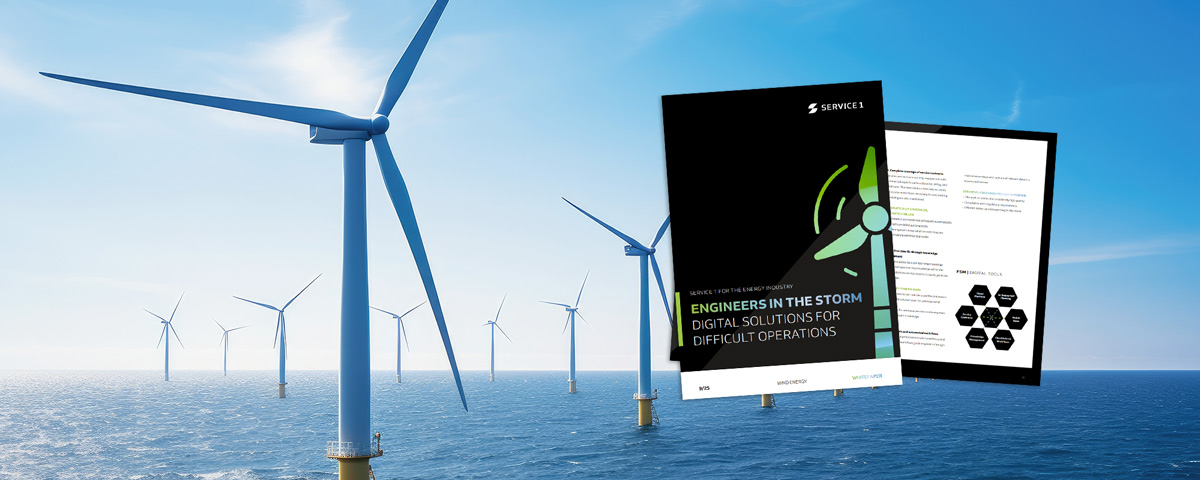
Engineers in the storm – whitepaper for wind service
Learn how a scalable, digital service platform reduces complexity, supports teams, and minimizes downtime – even during storms or in offline scenarios
FAQ – Field Service Management for renewable energy companies
Yes. Modern FSM solutions fully support offline scenarios. With the SERVICE 1 Mobile app, technicians can process service orders, complete checklists, and capture data without network connectivity. Synchronization occurs automatically once the connection is restored.
ERP systems primarily manage financials, inventory, and production processes. FSM software is specifically designed for managing mobile service operations. Scheduling, technician communication, mobile data access, and field reporting are core capabilities that ERP systems do not cover at this level of depth.
Decentralized assets, weather-dependent assignments, and limited visibility into maintenance activities complicate wind turbine operations. Without digital tools, technicians lose time due to long travel distances or incomplete documentation. FSM solutions reduce travel time and sustainably optimize routing.
FSM reduces planning effort by 20% (source: SERVICE 1) and technician time per job by 10%, with ROI achieved within 12–24 months. Asset availability increases through higher first-time fix rates and reduced downtime. Customer retention improves through transparent reporting. In the renewable energy sector, route optimization also significantly reduces CO₂ emissions.
Learn more: Renewable Energy | Quick Wins – Your path to digitalisation | Contact us directly